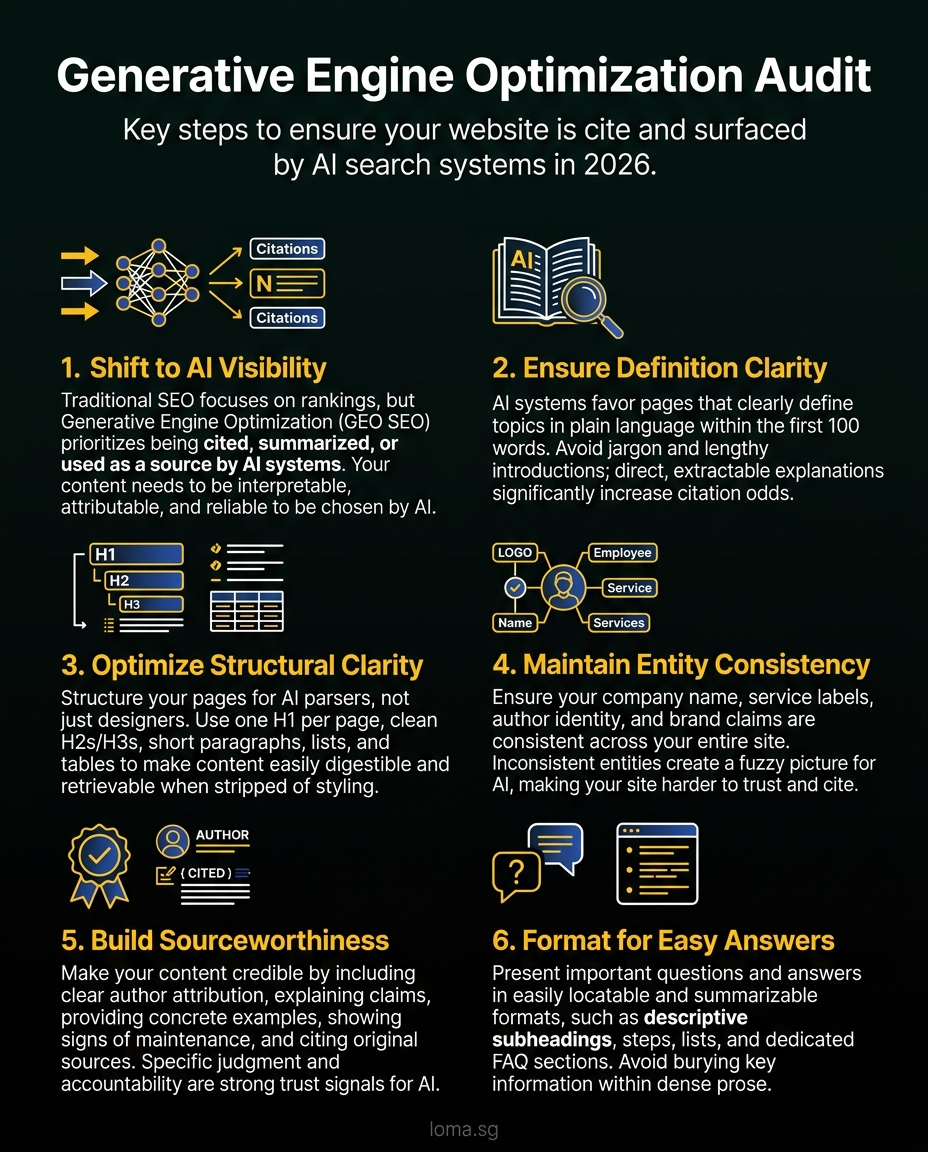
Most teams still audit SEO like it is 2022. Rankings, traffic, backlinks, done. That is not enough anymore. If ChatGPT, Perplexity, and Google AI Overviews cannot confidently interpret, summarise, and cite your site, you have a visibility problem even if a few pages still rank.
That is where a generative engine optimization audit comes in. Not as a trendy rebrand for SEO, but as a practical way to check whether your website is actually usable by AI-driven search systems.
If you are a founder or marketing lead, here is the blunt truth: many sites fail AI search not because the content is terrible, but because the signals are messy. Definitions are vague. pages overlap. key commercial pages lack evidence. FAQs are hidden in design components that search systems barely understand. Internal linking is random. Nothing on the site clearly says, "this brand is a reliable source on this topic."
A proper GEO SEO audit fixes that.
In this guide, we will break down a 7-point framework you can use to assess your current site, spot the common failure points, and decide what needs fixing first.
What AI search visibility actually means
AI search visibility is not just about whether your page ranks in ten blue links. It is about whether AI systems can:
- understand what your brand does
- extract a clean answer from your content
- trust your page enough to cite or summarise it
- connect your pages into a coherent topic cluster
- mention your brand when users ask commercial or informational questions
That changes the audit lens.
Traditional SEO asks, "Can I rank?"
AI search asks, "Can I be understood, selected, and cited?"
Those are related, but they are not identical.
A page can rank decently and still be poor AI source material. It might be too vague, too bloated, too inconsistent, or too thin on proof. A clearly structured page with sharp definitions and reliable claims is far easier to cite.
The 7-point GEO audit framework
A useful AI search visibility audit should tell you where your website becomes hard to interpret. These seven checks do exactly that.
1. Definition clarity: do your pages explain what you do in plain language?
The first GEO problem is usually obvious once you look for it. Many websites never define their services cleanly. They rely on slogans, category labels, or vague marketing copy.
That is a mistake.
AI systems need crisp definitions. If your page is about generative engine optimization, say what it is. Early. Clearly. In plain English. Do not dance around it with clever headlines and expect the model to fill in the blanks.
Audit this by checking:
- whether your primary service pages define the topic in the first 150 words
- whether the definition uses direct language instead of jargon
- whether similar pages contradict each other
- whether the same service is described with three different names across the site
If your homepage says "AI visibility systems," your service page says "GEO," and your sales deck says "AI SEO," you are creating entity confusion for both humans and machines.
A good rule is simple: one service, one primary label, one clear definition.
If your business needs help tightening service positioning, LOMA's AISEO services are built for exactly that kind of work.
2. Structural clarity: can AI systems extract your answers without guessing?
Your content structure matters more than most teams realise.
A page full of wall-of-text paragraphs, collapsible sections, vague headers, and floating design elements may look polished, but it is miserable to parse. AI systems are much more likely to cite content that is easy to segment.
Audit each priority page for:
- one clear H1
- descriptive H2s that match user questions or subtopics
- short paragraphs with one idea at a time
- bullet points or numbered steps where useful
- concise explanation blocks instead of ornamental filler
If your most useful answers are buried inside scripts, tabs, or accordions with weak headings, they are less reusable.
Structure is retrieval support.
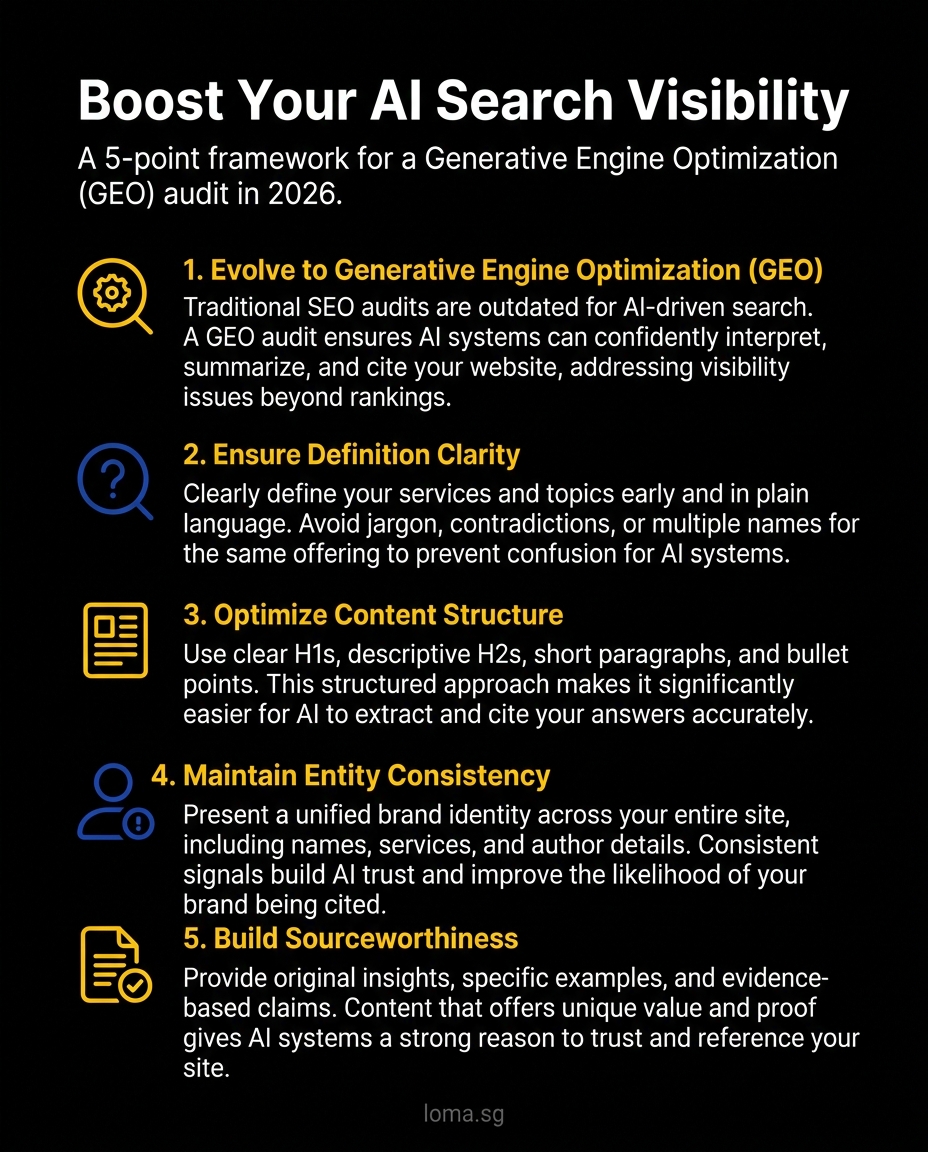
3. Entity consistency: does your site present one coherent brand?
AI systems do not just read individual pages. They infer entities, which means your company, your services, your expertise, and the relationships between them.
If your site sends mixed signals, citation confidence drops.
Check for consistency across:
- company name and legal name
- service naming
- author identity
- about page language
- contact details
- schema markup where relevant
- external profiles and citations
Here is a common mess: the homepage positions the brand as a digital marketing agency, the about page talks like a software studio, the blog speaks like a media publication, and the service pages use disconnected terminology. Technically, all of that can be true. Practically, it dilutes clarity.
AI systems reward coherent entities. The simpler and more internally consistent your brand model is, the easier it is to understand where you should be cited.
This is one reason internal brand pages like About matter more than people think. They are not just for credibility with buyers. They help establish a clean entity graph.
4. Sourceworthiness: have you given AI a reason to trust you?
A lot of websites want citations without offering evidence.
They make broad claims. They repeat popular opinions. They publish generic how-to pieces with no original viewpoint, no examples, no proof, and no clear expertise.
That is not sourceworthy.
To audit sourceworthiness, review whether your important pages include:
- first-hand insight or clear expert interpretation
- specific examples, scenarios, or implementation details
- named frameworks or decision criteria
- evidence-based claims rather than vague hype
- updated information that reflects current tools and behaviour
The best AI-citable content either explains a topic more clearly than everyone else, or adds a grounded opinion that helps the reader decide what to do.
If your article sounds like a cleaned-up version of fifteen other articles, it is easy to ignore. If it says, "Here is the exact failure pattern we keep seeing, and here is how to fix it," that is useful.
That is also why blog content should support service pages instead of drifting into generic publishing for its own sake. A strong content system links strategic articles back to core expertise pages like Digital Marketing or AISEO, reinforcing topical authority instead of scattering it.
5. FAQ and answer formatting: are you writing in a way AI can quote?
This is where many decent websites fall apart.
They have the right ideas, but the answers are hard to lift.
AI systems favour content that can be extracted into a clean response. That means your most important pages should include question-and-answer patterns where appropriate, especially for definitions, comparisons, process explanations, and buyer concerns.
Audit for:
- clear question-led subheads
- direct answers in the first sentence after the subhead
- concise definition paragraphs
- comparison tables or bullets where the topic benefits from contrast
- FAQ sections that address real objections, not filler questions nobody asks
Bad FAQ content sounds like this: "Why choose our company? Because we are committed to quality and innovation."
That is not an answer. It is wallpaper.
Useful answer formatting sounds like this: "What is generative engine optimization? It is the process of improving how your website is understood, cited, and surfaced by AI-driven search systems such as ChatGPT, Perplexity, and Google AI Overviews."
One of those can be quoted. The other is just wallpaper.
6. Internal linking logic: do your pages support each other, or compete with each other?
AI visibility is easier to build when your website behaves like a coherent knowledge base.
That means related pages should point to each other deliberately.
Audit your internal linking by checking:
- whether blog posts link to the most relevant service page
- whether service pages link to supporting blog content
- whether related articles connect around one topic cluster
- whether anchor text is clear, descriptive, and non-random
- whether orphan pages exist with no meaningful internal links
A weak internal link structure forces AI systems to infer relationships. A strong one states them directly.
This is also where many businesses accidentally create keyword cannibalisation. They publish three articles that all vaguely target the same topic, each with shallow overlap and no differentiated intent.
7. Content freshness: are your pages current enough to be trusted?
Freshness is not about rewriting everything every month. It is about whether your important pages still reflect how the market, tools, and user behaviour actually work now.
In AI search, stale content becomes a problem fast because platforms, interfaces, and citation patterns keep shifting.
Audit freshness by checking:
- whether pages reference outdated tools or obsolete features
- whether examples still match current search experiences
- whether statistics have aged badly
- whether older articles deserve an update, merge, or redirect
- whether key service pages still reflect what you actually sell today
A page from last year is not automatically stale. A page that still talks about AI search like a future possibility definitely is.
Common failure points that stop sites from getting cited in AI search
Once you run the audit, the same issues tend to show up.
Vague positioning
If your site never clearly states what you do, AI systems have to guess. Guessing is bad for visibility.
Thin service pages
Many commercial pages are too short, too generic, and too polished to be useful. They look finished, but they say very little.
Generic blog content
If your content sounds like every other agency article on the internet, it gives AI no reason to prefer you as a source.
Inconsistent terminology
When the same service is described in multiple conflicting ways, interpretation gets weaker.
Poor answer formatting
If answers are buried in decorative layouts, long intros, or weak headings, extraction becomes harder.
Broken topic clusters
When related pages do not link properly, your expertise looks fragmented.
Stale trust signals
Outdated examples, old service descriptions, and neglected about pages quietly erode authority.
Most GEO failures are not caused by one catastrophic issue. They come from layers of small ambiguity.
How to prioritise fixes after the audit
Do not try to rebuild the entire website at once.
Start in this order:
- Fix your core commercial pages first.
- Rewrite weak definitions and above-the-fold messaging.
- Improve structure on pages that should answer important buyer questions.
- Strengthen internal links between service pages and supporting articles.
- Refresh older content that still has authority potential.
- Add sharper FAQs and extractable answer blocks.
- Clean up brand and service naming across the site.
That order works because AI search visibility usually improves when your core signals get clearer, not when you publish five more generic blog posts.
More content is not the answer if the foundation is muddy.
When to bring in a specialist for a full GEO audit
If your site already has traffic, multiple service pages, and an existing content library, a DIY pass can get you started. But if your team is struggling with unclear positioning, overlapping content, weak internal linking, or no clear plan for AI search visibility, it is worth bringing in specialists.
A proper GEO audit should give you an implementation roadmap:
- which pages need rewriting
- which content should be merged or expanded
- what internal links need restructuring
- where entity confusion is hurting visibility
- how to improve citation readiness across commercial and editorial content
If you want a sharper view of how your site performs in AI-driven search, talk to LOMA about a structured Generative Engine Optimization and AISEO audit. We help brands turn vague AI search anxiety into a clear set of technical and content actions.