
AI search is reshaping eCommerce discovery faster than most brands realise. A buyer now asks ChatGPT, Gemini, Perplexity, or Google AI Overviews what to buy, which option fits a need, and which products are worth shortlisting before they ever touch a category page. If your store is not built for that layer of discovery, you are invisible earlier than your analytics can show.
That is why generative engine optimization matters. For eCommerce brands, GEO is not just about getting blog posts mentioned in AI answers. It is about making product pages, collection pages, comparison content, and support content easy for AI systems to extract, trust, and cite.
Most stores are not failing because they lack products. They are failing because their information architecture is messy, their product copy is thin, and their pages are written for a human skim and a search crawler, but not for an answer engine trying to assemble a recommendation. Those are different jobs.
If you sell online, the goal is simple: make your site easier for AI systems to understand than your competitors' sites.
Why AI Search Changes eCommerce Discovery
Traditional search rewarded stores that ranked a category page, won the click, and then pushed the user through filters, product grids, and internal navigation. AI search compresses part of that journey. Users ask more specific questions upfront:
- Which standing desk is best for a small home office?
- What is the difference between ceramic and titanium cookware?
- Which air purifier is good for pet owners in an apartment?
Those queries create shortlists before the user lands anywhere. That matters because shortlist formation is where a lot of purchase intent hardens.
In normal SEO, you could still survive with a decent collection page and strong paid retargeting. In AI search, weak product and category data gets punished earlier. If the model cannot understand your offer clearly, it will cite another brand, a marketplace, a publisher, or a review site that did the explanation better.
For eCommerce brands, that means three things.
1. Discovery happens before the click
Your site is no longer the first place a buyer learns what a product does. AI systems often do the framing first. They summarise categories, compare options, explain tradeoffs, and recommend formats.
If your store only makes sense once a human is already browsing it, you are already late.
2. Category rankings are no longer enough
A ranking collection page still matters, but it cannot carry the whole strategy. AI systems pull from supporting pages, product details, FAQs, comparison copy, third-party mentions, and structured data. They do not think in the same siloed way most SEO teams do.
A store that ranks for a category but explains nothing clearly can still lose citations to a smaller brand with cleaner content.
3. Commercial intent is becoming answer-led
Informational queries were the first wave of AI search. Product research is the next obvious frontier. Buyers want help narrowing choices, understanding features, and reducing the risk of a bad purchase.
That is good news for brands with strong site structure. It is bad news for stores built on duplicated supplier descriptions and lazy collection pages.
What AI Systems Need From Product and Category Pages
Generative engine optimization works when your pages are easy to parse, compare, and trust. Fancy design does not help if the underlying content is vague.
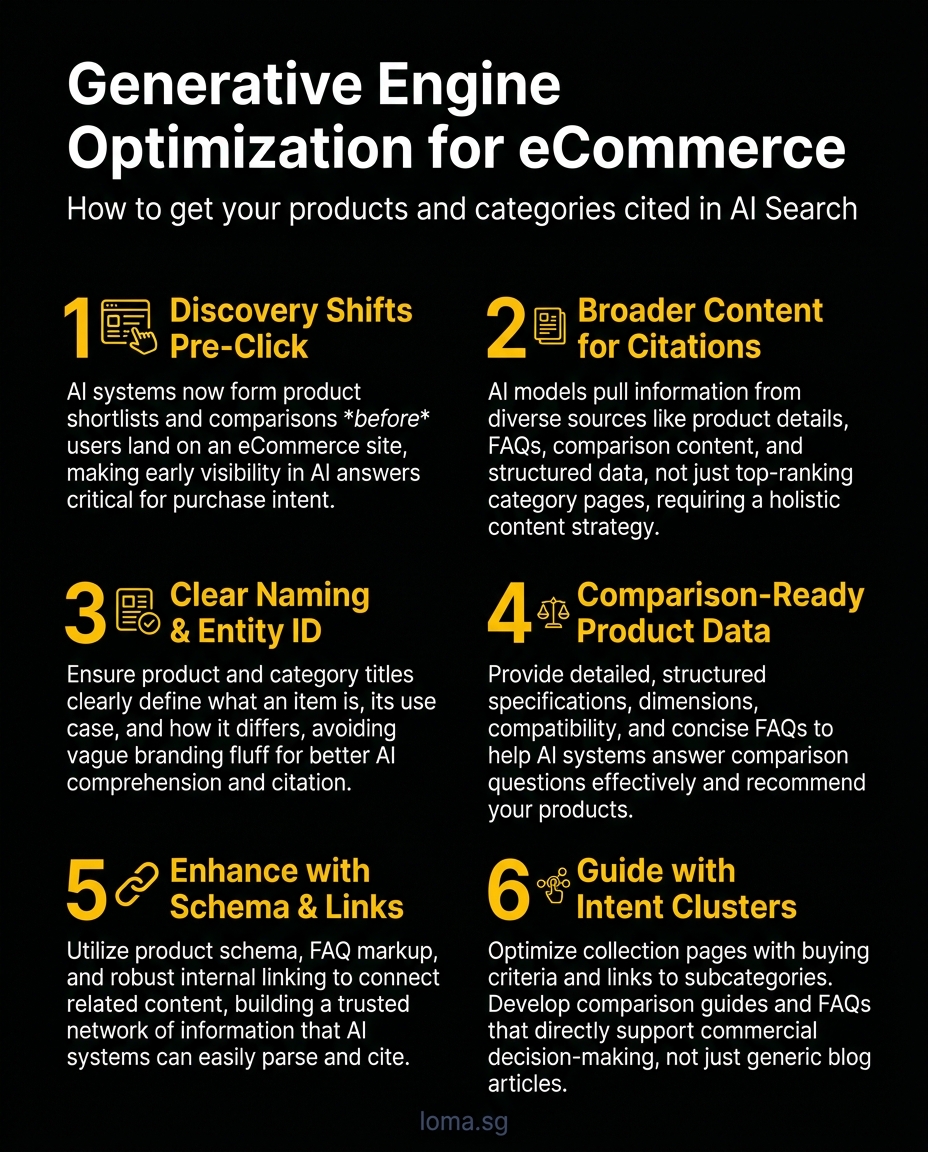
Clear product and entity naming
AI systems need to identify what the item is, who it is for, what it does, and how it differs from adjacent options.
That sounds obvious, but plenty of stores bury the useful information under branding fluff or internal naming conventions. A product title like "Series X Pro Max" means almost nothing on its own. A title and description that clarify product type, use case, size, material, or compatibility are far more useful.
The same applies to category pages. "Essentials" or "Signature Collection" may sound premium, but they are weak labels if a machine cannot infer intent from them. A collection page should express what kind of products live there and what job they solve.
Structured specifications and comparison-ready copy
AI models are constantly asked comparison questions. Which one is better, cheaper, lighter, safer, faster, easier to maintain, or better suited to a particular use case?
If your product page only has emotional copy and a few bullet points, you are giving the model almost nothing to work with.
Strong product pages include:
- structured specs
- dimensions and materials
- compatibility details
- clear pricing context
- delivery or warranty information where relevant
- concise FAQs
- plain-language explanation of who the product is for
This is not about stuffing more text everywhere. It is about making commercial information legible.
Schema and internal linking that support interpretation
Schema alone will not win citations, but it helps reinforce what the page is about. Product schema, offer details, review signals where appropriate, FAQ markup, and breadcrumb structure all make your content easier to classify.
Internal linking matters just as much. Product pages should connect naturally to category pages, comparison articles, buyer guides, and use-case content. That creates a network of context instead of a pile of isolated URLs.
If an AI system lands on a category page and can follow links to a buying guide, a sizing explainer, and a relevant product range, your store becomes easier to trust as a complete source.
Supporting explanatory content
A good store does not rely on product pages to do every job. Product and collection pages handle transactional clarity. Supporting content handles decision support.
That includes:
- comparison pages
- buyer guides
- use-case explainers
- FAQ articles
- category education pages
This is where many brands misunderstand GEO SEO. They hear "AI search" and immediately start publishing generic blog articles. That is the wrong instinct. Supporting content only works when it connects directly to commercial discovery and reinforces your store structure.
The GEO Playbook for eCommerce Brands
If you want product and collection pages cited in AI search, focus on the system, not isolated pages.
Optimise collection pages around intent clusters
Most collection pages are glorified product grids. That is lazy SEO, and it is even worse GEO.
A collection page should explain:
- what the category covers
- who it is for
- how to choose within the category
- what differentiates the major subtypes
- what adjacent collections matter next
Think in intent clusters, not just product taxonomy. A user searching for "best ergonomic office chair for small apartment" is not looking for a generic office chair category page with 48 cards and no guidance.
A stronger collection page includes a short intro, buying criteria, internal links to subcategories or guides, and copy that helps both people and machines understand the decision landscape.
Build comparison and buyer-guide content around commercial queries
Comparison pages are one of the best bridges between SEO and conversion because they map directly to how people evaluate products.
Useful examples include:
- product type vs product type
- entry model vs premium model
- material comparison pages
- best-for-use-case guides
- "how to choose" pages for a category
The point is not to create content for volume alone. The point is to create assets that an AI system can cite when answering a research query.
A buyer guide that clearly explains tradeoffs often has a better chance of being cited than a thin category page. When that guide links into relevant collection and product pages, your commercial pages benefit too.
Improve machine-readable structure across PDPs and PLPs
This is where revenue-minded teams gain an advantage. Most GEO advice online stays abstract. eCommerce teams need operational fixes.
Start with your PDPs and PLPs:
- standardise attribute formatting
- clean up variant logic
- make specs consistent across similar products
- remove duplicate or contradictory descriptions
- align headings with actual user questions
- ensure availability, price, and shipping context are easy to parse
If you run Shopify, WooCommerce, or a custom storefront, the platform is not the real issue. The issue is usually content discipline.
When product data is inconsistent, AI systems do what humans do. They move on.
Strengthen citations beyond your own site
AI systems do not rely only on your store. They also look at the wider web. That means off-site citations, mentions, reviews, relevant directory listings, marketplace presence, and expert roundups still matter.
For some brands, this is the missing layer. They optimise onsite content but have weak corroboration elsewhere, so a model cites publishers and review sites instead.
That is why a serious GEO strategy often overlaps with digital marketing execution, content distribution, and authority building. You are helping answer engines see that your store is not just saying the right things, it is recognised as a useful source.
Common Mistakes That Keep Stores Out of AI Answers
Most eCommerce brands do not need a grand strategy deck first. They need to stop making the same preventable mistakes.
Thin manufacturer copy
If your product pages reuse supplier text with minimal edits, do not expect differentiated visibility. AI systems have probably seen the same wording across dozens of sites.
That makes your page easy to replace.
Rewrite product copy around use case, buyer concerns, differentiators, and decision support. Originality here is not a branding luxury. It is a visibility requirement.
Messy taxonomy and duplicate intent
Too many stores create overlapping categories, weak filters, and near-identical collection pages. That confuses users and machines.
A clean taxonomy is underrated because it feels operational, not glamorous. But it directly affects how easily an answer engine can understand your catalogue.
If five pages target the same intent with slightly different labels, none of them becomes a strong citation candidate.
No supporting educational content
A store without support content forces AI systems to find explanations elsewhere. That means someone else gets cited for the research phase, and your brand only gets considered later, if at all.
You do not need a bloated blog. You need focused commercial education.
This is where AISEO and GEO strategy becomes useful. Done properly, it aligns content structure with how AI systems assemble answers, instead of just chasing old ranking patterns.
Treating GEO like blog publishing only
This is the biggest mistake. GEO for eCommerce is not a content marketing side quest. It is a site architecture, product data, and content design problem.
If your team publishes articles but leaves product pages weak, category pages empty, and internal links shallow, you are solving the least important part first.
Blogs can support citations. They cannot rescue a structurally weak store.
What to Prioritise First if You Sell Online
If your store is already live, do not try to fix everything at once. Prioritise in the right order.
1. Fix your core collection pages
Start with high-value categories. Improve naming, introductory copy, buying guidance, internal links, and subcategory logic.
If a collection page cannot help a user narrow choices, it is not GEO-ready.
2. Upgrade top product pages with real decision support
Pick products that drive revenue or represent strategic categories. Add structured specs, clearer positioning, FAQs, comparison context, and original copy.
Do this well on a smaller set before scaling across the catalogue.
3. Add commercial support content
Create comparison pages, buyer guides, and use-case articles around real pre-purchase questions. Link them tightly to relevant collection and product pages.
This is where AI search optimization for ecommerce becomes practical. You are not creating content for vanity traffic. You are shaping the research path.
4. Clean up sitewide consistency
Standardise schema, breadcrumbs, attribute labels, and product information formatting across templates. Machines notice inconsistency quickly.
Humans do too, they just complain less directly.
5. Build external corroboration
Strengthen the broader footprint around your brand through reviews, mentions, relevant partnerships, and citation-worthy content assets. Visibility inside AI answers is partly earned offsite.
The Real Question: Is Your Store Easy to Cite?
That is the test worth using.
Not whether your site has a blog. Not whether you added schema once. Not whether an SEO plugin says your metadata is green.
Ask whether an AI system can confidently extract your products, understand your categories, compare your options, and cite your pages without doing interpretive gymnastics.
If the answer is no, your competitors do not need a better ad budget to beat you. They just need cleaner information.
LOMA helps brands close that gap by combining eCommerce architecture, content strategy, and AI search readiness. If your store needs stronger category structure, better commercial content, or a sharper GEO roadmap, explore our eCommerce services and see how we build stores that are easier to discover, easier to trust, and easier to grow.