The search market in Singapore has a new vocabulary problem. Everyone suddenly talks about GEO SEO, and half the advice sounds like SEO got a new coat of paint so agencies could sell the same thing twice.
That is not what is happening.
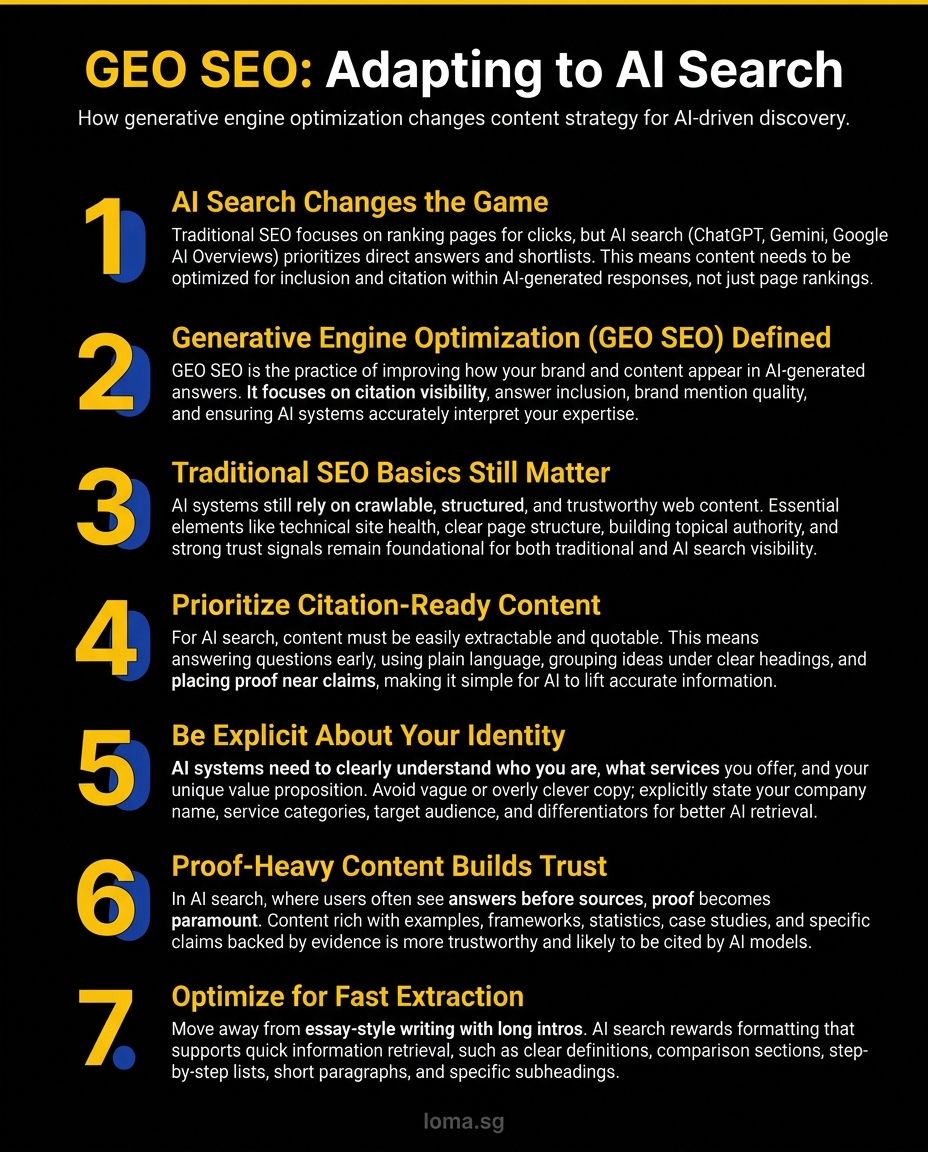
GEO SEO is real, but it is not a replacement for traditional SEO. It is a shift in how visibility is earned when buyers ask ChatGPT, Gemini, Perplexity, or Google AI Overviews for answers instead of clicking ten blue links. If your team treats AI search like a fad, you will miss where attention is moving. If you treat it like magic, you will waste time producing content that sounds polished and gets cited nowhere.
The practical answer sits in the middle: keep the fundamentals that make your site trustworthy, then adapt your content so AI systems can extract, verify, and cite it.
What GEO SEO actually means
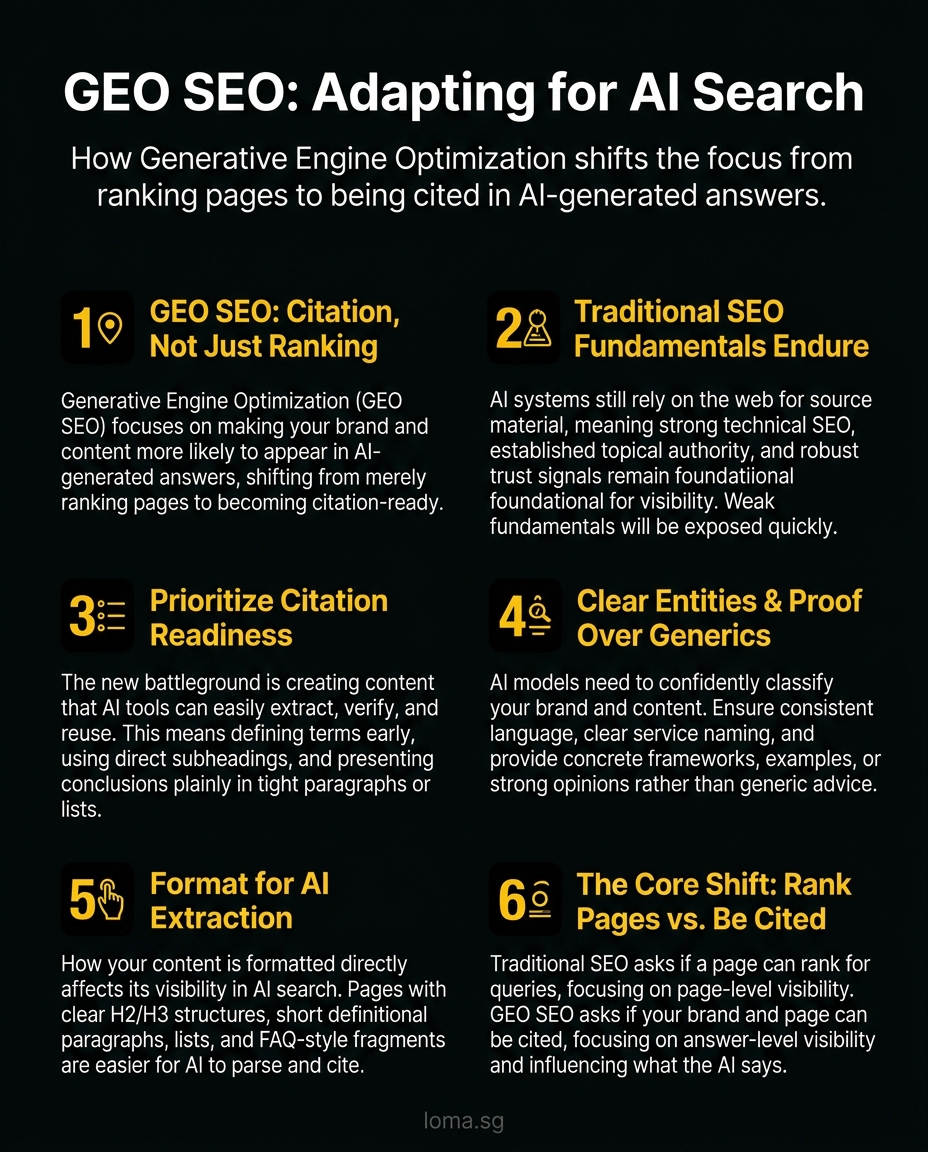
Generative engine optimization is the work of making your brand and content more likely to appear in AI-generated answers. That includes direct citations, indirect influence, and better visibility when large language models summarise options for a buyer.
Traditional SEO is mostly about ranking pages for search queries. GEO SEO is about becoming citation-ready when the interface changes from a list of results to an answer engine.
That difference matters.
In traditional search, a page can still win with a strong title tag, good backlinks, and a decent match to the keyword intent. In AI search, the model often compresses several sources into one response. Your page is not just competing to rank. It is competing to be trusted, extracted, and reused.
So no, GEO is not just SEO with different branding. But it is also not a totally separate discipline. Think of it as the next layer on top of solid SEO. If your fundamentals are weak, AI search will expose that fast.
What stays the same from traditional SEO
The hype makes people forget something obvious: AI systems still need source material. They are not inventing authority out of thin air. They rely on the web, and the web still rewards the same structural signals that have mattered for years.
Technical foundations still matter
If your site is slow, messy, hard to crawl, or loaded with duplicate pages, nothing good happens. Search engines struggle to understand it. AI systems are less likely to find consistent, reliable source material.
That means the boring work still counts:
- Clear site architecture
- Proper indexation
- Fast-loading pages
- Clean internal linking
- Descriptive titles and headings
- Canonical control
- Strong mobile experience
There is no version of GEO where technical debt becomes charming.
Topical authority still wins
AI search prefers confidence backed by context. Brands that publish one shallow article on a topic and disappear do not look authoritative. Brands that build clusters, explain concepts clearly, and support claims with examples have a much better shot.
If you want to show up for GEO SEO, your site should already demonstrate a point of view on SEO, content strategy, AI visibility, and search behaviour. Authority is not one article. It is pattern recognition.
Trust signals matter even more
Traditional SEO has always cared about credibility, even when people pretended otherwise. AI search just makes the requirement stricter.
Models are more likely to lean on sources that feel structured, specific, and defensible. That means:
- Clear authorship or brand attribution
- Real case examples
- Specific methods
- Updated content
- Consistent terminology
- About and contact pages that make your business look real
Thin affiliate-style writing was already weak. In AI search, it becomes nearly useless.
What changes when buyers use AI search
This is where most teams need a reset. The job is no longer only to rank a page. The job is to create content that can survive summarisation.
Citation readiness becomes the new battleground
When someone asks an AI tool, "What is the difference between GEO SEO and traditional SEO?" the system looks for concise, trustworthy passages it can reuse. If your content buries the answer under vague introductions and padded filler, you make extraction harder.
Answer-friendly content is not dumbed down content. It is structured content.
That means you should:
- Define key terms early
- Use direct subheadings that mirror real questions
- Give clean comparisons
- State conclusions plainly
- Keep important points in tight paragraphs or bullet lists
A lot of content marketers hate this because it removes their favourite trick, which is saying very little in 1,800 words.
Entity clarity matters more than clever copy
AI systems need to understand who you are, what you do, and what category you belong to. If your site language is inconsistent, your services overlap confusingly, or your content uses three different labels for the same thing, you create ambiguity.
Traditional SEO can sometimes tolerate fuzzy positioning if backlinks and page targeting are strong. GEO is less forgiving. A model will not confidently cite a brand it cannot classify.
For most businesses, this means cleaning up:
- Service naming
- Page hierarchy
- Brand descriptions
- Repeated explanations across the site
- Supporting schema and structured context
If your agency offers AISEO, SEO, content strategy, and AI consulting, explain how those fit together. Do not make the reader or the model guess.
Proof-heavy content beats generic advice
AI-generated answers compress the web. Generic advice gets flattened first.
If your article says, "Create helpful content and optimise user experience," congratulations, you sound like everyone else. There is nothing worth citing there.
What gets reused is sharper:
- A clear framework
- A decision rule
- A comparison table
- A concrete example
- A strong opinion backed by reasoning
This is why businesses chasing AI visibility should stop publishing content that looks like it was assembled from ten mediocre SEO blogs. AI systems do not need another bland summary. They need source material with substance.
Format now affects visibility more directly
Traditional SEO let some ugly pages rank if they had enough authority. AI search is more sensitive to formatting because extraction is part of the outcome.
Pages that work better tend to have:
- Clear H2 and H3 structure
- Short definitional paragraphs
- Lists and comparison sections
- FAQ-style fragments where useful
- Consistent terminology
- Minimal fluff before the real answer
This does not mean every article should read like documentation. It means the information should be easy to parse without heroic effort.
GEO SEO vs traditional SEO: the simplest way to think about it
If you need a working mental model, use this:
Traditional SEO asks: can this page rank?
The focus is page-level visibility. You want impressions, clicks, and qualified traffic from search results.
GEO SEO asks: can this brand and this page be cited?
The focus is answer-level visibility. You want your expertise, wording, and evidence to influence what the AI says.
Those are related goals, but they are not identical.
A page can rank and still be poor source material for AI answers. It can be keyword-aligned yet vague. It can be authoritative yet badly structured. It can get traffic and still fail to shape the summary the buyer reads.
That is the gap teams need to close.
What businesses should change first
Do not start by spinning up twenty "AI search" articles. That usually creates more noise, not more visibility.
Start here instead.
1. Audit your core service pages for clarity
Before writing net-new content, make sure your money pages clearly explain:
- What you do
- Who it is for
- What problems it solves
- How your approach differs
- What proof supports your claims
If your main service pages are soft, no blog strategy will save them. For businesses refining positioning and messaging, your broader digital marketing strategy still needs to support the foundations.
2. Upgrade existing articles into answer assets
Look at content that already ranks or gets impressions. Tighten the intros. Add comparisons. Clarify definitions. Insert proof. Improve headings.
This is often more valuable than publishing something new because you are improving pages that already have some authority and discovery.
3. Build topic clusters around commercial intent
A lot of teams respond to AI search by publishing high-volume informational fluff. That is backwards.
You want clusters that help buyers move from awareness to evaluation. If you offer AISEO, build supporting content around citations, AI visibility, search behaviour shifts, and content structures that influence answers. Then connect those pages logically to your main AISEO / GEO service.
4. Write with extraction in mind
This is the operational shift most content teams need.
Every article should contain a few passages that could stand alone as a cited answer. If you cannot lift a paragraph from your page and have it still make sense, the content is probably too padded.
5. Track more than rankings
Rankings still matter. They are not enough.
Teams should also watch for:
- Brand mentions inside AI answers
- Citation frequency where visible
- Changes in branded search volume
- Assisted conversions from informational content
- Sales feedback on how prospects found you
The buyer journey is getting messier. Your measurement has to catch up.
When GEO is overkill
Not every business needs a full GEO SEO initiative tomorrow.
If your site has serious technical issues, weak service pages, or no real content strategy yet, fix those first. Traditional SEO is still the base layer. You do not skip foundation work because AI search is trendy.
Also, if your category has low AI-search behaviour today, the return may not justify a major standalone effort yet. Some industries are moving faster than others.
The mistake is not waiting. The mistake is assuming the shift is irrelevant until traffic drops and pipeline follows.
The blunt conclusion
Traditional SEO still matters because search engines still need structured, credible pages. GEO SEO matters because buyers increasingly rely on AI-generated answers before they ever click.
So what actually changes?
The standard gets higher.
You are no longer optimising only for rankings. You are optimising for retrieval, interpretation, and citation. That forces better content discipline. Clearer positioning. Stronger proof. Cleaner structure.
Honestly, that is a good thing.
A lot of bad content was surviving because it knew how to chase keywords. AI search raises the bar by asking a harder question: is this source actually useful enough to trust?
If your answer is yes, GEO becomes an opportunity, not a threat.
If you want an AISEO strategy that improves both rankings and AI visibility, LOMA can help. Explore our AISEO / GEO approach or contact us to map out what should be fixed first.