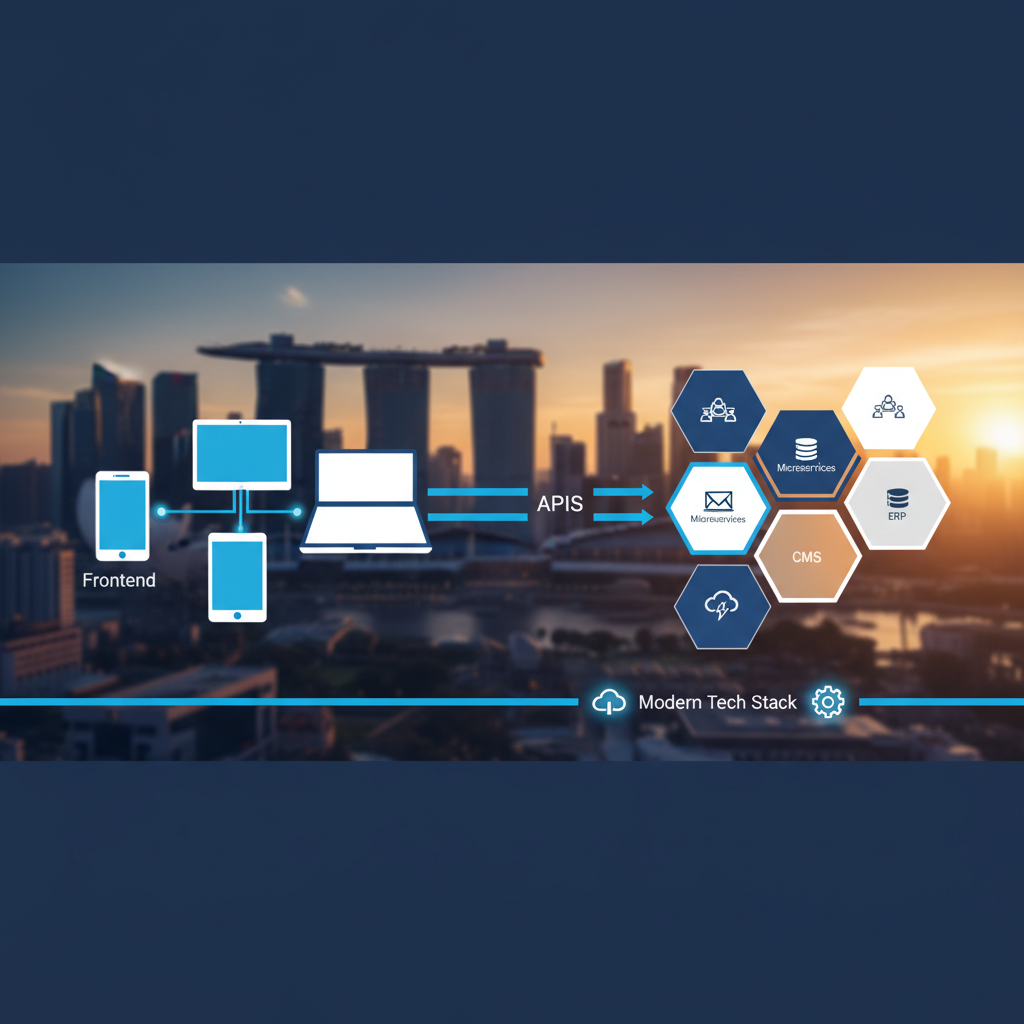
Shopify and WooCommerce work. That's not an opinion: it's a fact backed by millions of merchants worldwide. If you're a Singapore SME that launched on either platform, made your first sales, and grew to meaningful revenue, that platform did its job.
But there's a ceiling. The brands looking at headless ecommerce in Singapore aren't abandoning Shopify or WooCommerce out of frustration. They've outgrown them. And if you're reading this, you've probably started to feel the difference.
The Platform Ceiling: When Shopify and WooCommerce Become Your Constraint
You don't outgrow these platforms all at once. It happens gradually: a checkout customisation that requires a developer every time, a campaign that slows your site to a crawl, an inventory system that won't sync cleanly. Each issue has a workaround. Then the workarounds start stacking up.
The Shopify Ceiling
Here's what that ceiling looks like on Shopify:
- Your checkout flow needs custom logic (split payments, deposit-then-balance, bundles with different tax rules) and every change is a developer ticket
- Your site loads in 3–4 seconds under normal traffic. During a sale, it's worse. Your conversion rate tracks directly with load time.
- You're running WhatsApp, physical retail, and an online store — and inventory is always slightly out of sync across all three
- You want to add an AI product recommendation engine. Shopify's app ecosystem has options, but none of them connect cleanly to your actual customer data.
The WooCommerce Ceiling
WooCommerce looks like freedom — you own your server, you control everything. In practice, that ownership becomes overhead:
- Performance degrades as your catalogue grows. More products, more plugins, more page weight. A WooCommerce store with 500+ SKUs and five or six plugins (shipping, payments, subscriptions, reviews) routinely struggles to hit acceptable load times without expensive infrastructure.
- Plugin conflicts are a constant operational risk. Every update to WooCommerce core, WordPress, or a third-party plugin is a potential breaking change. Maintaining stability requires vigilance that scales with your store's complexity — not your revenue.
- Security patching is your responsibility. Unlike hosted platforms, WooCommerce stores run on your stack. Missed patches mean exposure. Hosting, SSL, firewalls, and database backups are costs and maintenance burdens you carry.
- Checkout customisation requires PHP development or plugin workarounds. Custom order flows, conditional shipping rules, and loyalty integrations are achievable — but expensive to build and fragile to maintain.
- Integration with modern AI tools and headless services is possible via REST APIs, but WooCommerce was not designed to be API-first. You're adding API functionality onto a system built around server-rendered pages, which shows in both performance and integration complexity.
None of this means WooCommerce is bad. It means the self-hosted model carries real operational costs that a growing business eventually outgrows. And that's where headless ecommerce starts making sense for both platforms.
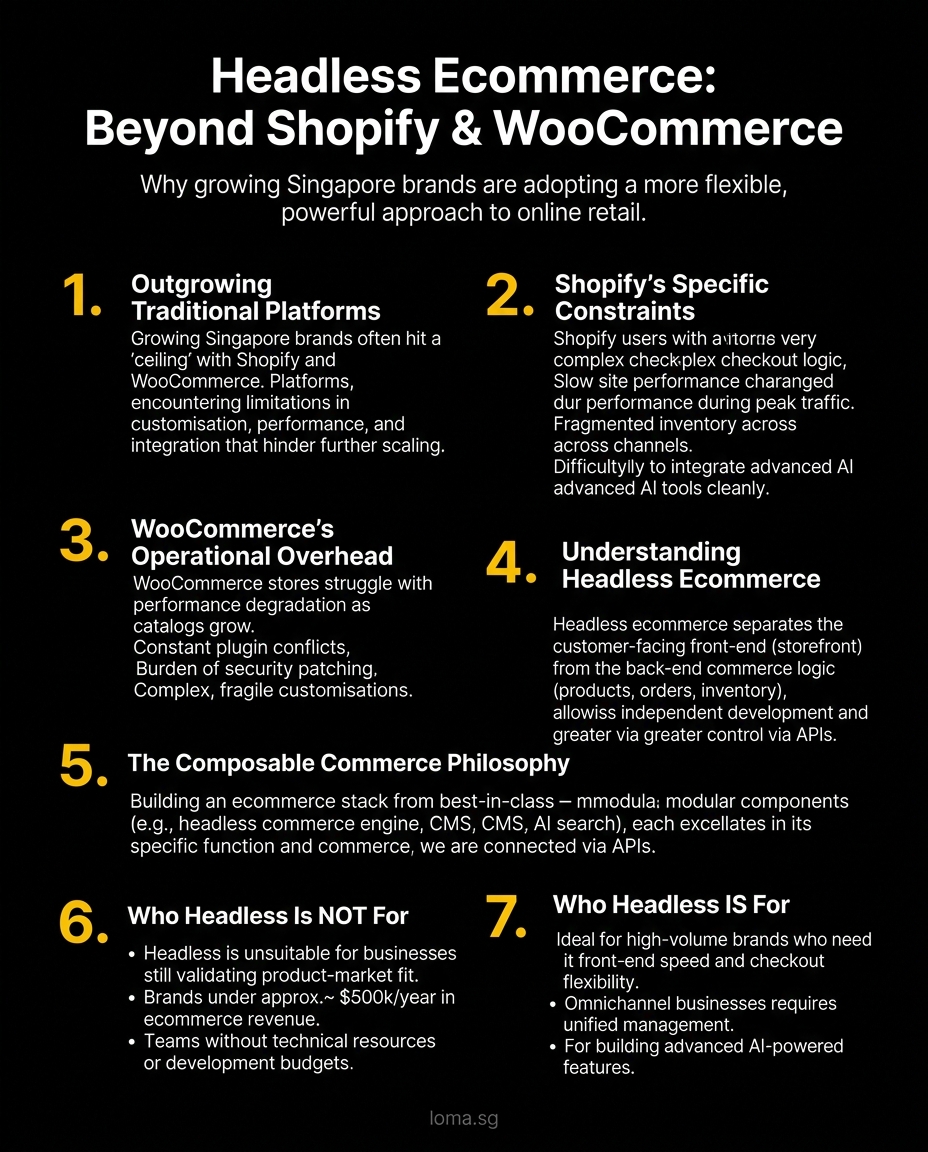
What Headless Ecommerce Actually Means
The jargon is enough to make most people stop reading. It doesn't need to be complicated.
Traditional ecommerce platforms like Shopify and WooCommerce couple the front-end and back-end together. The back-end handles your products, orders, inventory, payments, and customer data. The front-end is what your customers see: the storefront, the product pages, the checkout. On both platforms, these live in the same system — and the platform controls the experience end to end.
Headless separates them. Your back-end still handles products, orders, and inventory — but it exposes all of that data via APIs. Your front-end is built independently, usually in React or Next.js, and pulls exactly what it needs from those APIs. The two systems talk to each other but don't depend on each other.
Think of it like a car. A traditional platform is a car where the engine and body are fused — you can't upgrade one without replacing the whole thing. Headless separates the engine from the body. You can rebuild the storefront without touching the commerce logic underneath. You can swap the payment provider without redesigning the checkout experience.
The result: you control everything the customer sees and does. You're not working within Shopify's design system, Shopify's checkout constraints, or WooCommerce's WordPress page-builder stack. You're building exactly what your business needs.
Composable Commerce: The Next Step
Headless is the architecture. Composable commerce is the philosophy.
Instead of one platform trying to do everything, composable commerce means building your stack from best-in-class modular components: a headless commerce engine for orders and inventory, a CMS for content, an AI search engine for product discovery, a loyalty platform, a PIM for product data management. Each component does one thing well. They all connect via APIs.
LOMA uses Medusa as the commerce back-end for most headless builds. It's open-source, built specifically for composable commerce, and handles the complex parts (orders, fulfilment, returns, multi-currency) so the front-end team can focus on the experience. For brands migrating from WooCommerce, this also means leaving behind the WordPress dependency entirely — moving to a modern, API-first back-end that doesn't carry the plugin overhead. The result is an enterprise-grade commerce engine at a fraction of the traditional cost, which makes this model viable for growing SMEs, not just large brands with seven-figure tech budgets.
Who Headless Ecommerce Is Right For (And Who It's Not)
This is where most agency content fails: it makes headless sound like the right move for everyone. It's not.
Headless is NOT right for:
- Businesses still validating product-market fit. If you're not sure what you're selling or to whom, a complex technical infrastructure is the last thing you need.
- Brands under approximately $500k/year in ecommerce revenue. The development investment doesn't compound fast enough at lower volumes.
- Teams with no technical resources or budget for development. Headless requires a build — someone has to build it and maintain it.
Headless IS right for:
- Brands doing real volume who need front-end speed and checkout flexibility. If load time and conversion rate are directly connected to your revenue, the maths work. WooCommerce stores especially see dramatic performance gains — moving off WordPress and page builders alone can cut load times significantly.
- Businesses running omnichannel — online, WhatsApp, physical retail, or marketplace — where unified inventory and order management matter. Both Shopify and WooCommerce struggle here at scale; headless solves it cleanly.
- Brands building AI-powered features. Personalisation engines, AI product recommendation, voice search, and AI assistants all connect cleanly to a headless back-end via APIs. With a coupled platform — Shopify or WooCommerce — you're fighting the architecture every step.
- Companies planning international expansion. A headless stack handles multi-region, multi-currency, and multi-language cleanly. Both Shopify and WooCommerce have internationalisation features, but both carry constraints that compound as your market footprint grows.
The honest question: are the constraints of your current platform actively costing you revenue or slowing down your roadmap? If yes, headless is worth a serious look. If not, stay where you are and invest in product and marketing instead.
Real Performance Gains: What to Expect
Headless isn't a magic conversion lever. But there are real, documented performance improvements when the build is done well.
Page speed: A well-built Next.js storefront consistently achieves Largest Contentful Paint (LCP) under 2 seconds. Google's research puts a 1-second delay in page load time at a 7% conversion rate reduction. For a store doing $2M/year in ecommerce revenue, that 7% has a dollar value. WooCommerce migrations tend to see the most dramatic speed improvements — the move from a WordPress-rendered, plugin-heavy stack to a modern static-first front-end can cut load times by 60–70%.
Core Web Vitals: Headless builds routinely score 90+ on Google's Lighthouse performance audit. This affects your SEO ranking, particularly on competitive product category terms. If your WooCommerce store is sitting at 40–60 on Lighthouse — which is common for stores with multiple plugins and a page builder — this is one of the clearest technical SEO gains you can make.
AI integration: When your commerce back-end is API-first, connecting an AI assistant or personalisation engine is a matter of API calls, not workarounds. Your AI assistant for ecommerce connects directly to live product data, cart state, and customer purchase history. On Shopify or WooCommerce, that kind of integration requires approved apps, plugin compatibility checks, and workarounds that break on update cycles.
What we don't promise: specific conversion rate lifts or revenue increases. Site performance is one factor in conversion. Product, pricing, trust signals, and traffic quality all matter too. A faster site won't fix a product people don't want.
What a Headless Migration Actually Involves
The most common question: what does this actually cost and take?
Timeline: A mid-size catalogue headless build runs 12–16 weeks from kickoff to launch. That covers architecture decisions, front-end design and build, integration with your back-end systems (ERP, CRM, inventory), testing, and launch. Simpler builds with a smaller catalogue can move faster; complex integrations take longer.
What stays: Your product data, customer records, and order history migrate to the new back-end. Nothing your customers care about disappears. For WooCommerce migrations, this also means leaving behind the plugin subscriptions, hosting costs, and maintenance overhead — the total cost of ownership often shifts meaningfully in your favour once you factor those in.
What changes: The entire front-end. Your storefront is rebuilt from scratch — which is the point. You get to design the exact experience you want, not the experience Shopify's theme system or a WordPress page builder allows.
Cost: More than staying on Shopify or WooCommerce. Significantly less than the revenue impact of a platform that can't grow with you. The investment case for headless is about capacity and velocity: can your current platform support the next 3 years of your growth plan? If the answer is genuinely yes, stay. If you're already hitting ceilings, the question is when to move, not whether.
For a deeper look at the custom ecommerce vs Shopify decision, including cost benchmarks and when to make the switch, that post covers the comparison in detail.
Building on a Foundation That Scales
The brands that move to headless ecommerce aren't abandoning what worked. They're investing in a foundation that can handle what comes next.
That means: faster storefronts that convert better. Checkout flows built around your business logic, not around what an app store or plugin will allow. AI features that connect to real data. Omnichannel infrastructure where inventory, orders, and customers exist in one place, not three. And for WooCommerce brands specifically: a path off the WordPress maintenance treadmill, onto a modern stack that your team can actually build on.
See also: ecommerce website design for a broader look at what a high-performance ecommerce build involves, from architecture to design.
The headless ecommerce Singapore conversation is still early. Most brands here haven't made the move yet. That's the window.
Ready to Move Beyond Your Current Platform?
LOMA builds headless ecommerce on Medusa for Singapore brands ready to scale beyond Shopify or WooCommerce. If you're hitting the limits of what either platform can do for your business, we'll tell you honestly whether headless makes sense — and if it does, what the build looks like.