
Your brand ranks on page one of Google. Good. But when a Singapore SME owner asks ChatGPT "who should I hire for digital marketing?" or queries Perplexity for "best ecommerce solutions for local businesses," your Google ranking is irrelevant. AI answer engines don't browse Google. They pull from sources they trust.
If you're not one of those sources, you don't exist in that answer.
This is what AI answer engine optimization (GEO) is actually about. Not chasing an algorithm. Not optimising for robots. Getting your brand into the set of sources that AI models pull from when they generate answers for your potential customers.
Here's how to do it in the next 90 days.
How AI Engines Decide What to Cite
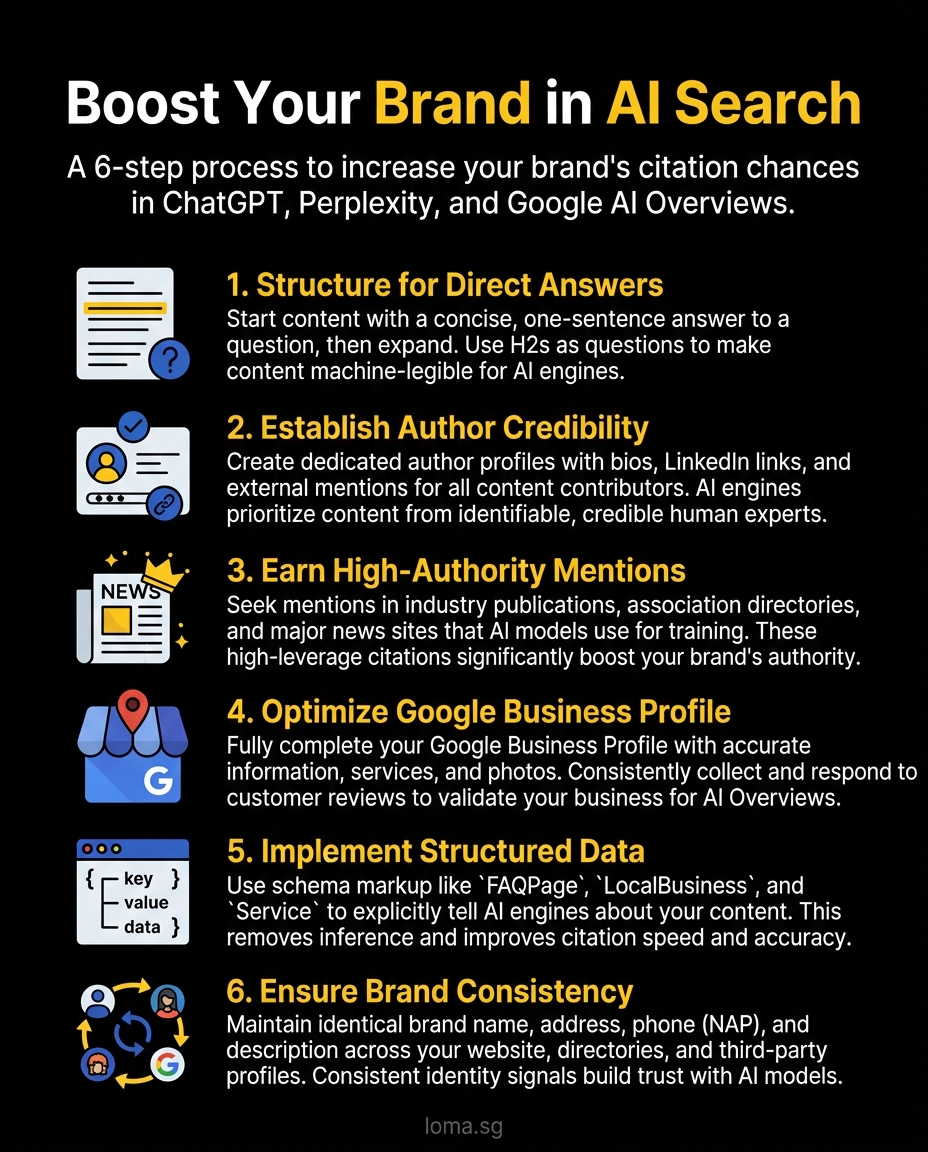
Before you can improve your chances, you need to understand the selection logic. ChatGPT, Perplexity, and Google AI Overviews all behave differently, but three signals consistently drive citation.
Authority signals. AI models are trained on, or draw from, sources that other credible sources have already validated. If you're mentioned in industry publications, referenced on reputable directories, or cited by other authoritative websites, that creates a signal trail AI engines can follow. Think of it as off-page SEO, but for training data and retrieval.
Content structure. AI engines are optimised to find direct answers. They don't need to read 2,000 words to find your point if you bury it. Pages that open with a clear definition, answer questions in H2/H3 blocks, and use FAQ sections are far easier for AI to extract and cite. The structure of your content matters as much as its quality.
Schema markup and structured data. This is how you formally tell AI engines who you are. Schema communicates your business name, location, services, reviews, and relationships in machine-readable language without requiring an AI to infer anything. If you haven't read our post on schema markup and structured data, do that first. It's foundational.
Understanding these three factors shapes everything that follows.
Seven Concrete Actions to Increase AI Citation
This is the work. Not theory. Not "create great content" (useless advice). Specific, executable steps, each with a measurable outcome.
1. Write Direct-Answer Content
AI engines favour content that answers a question clearly, quickly, and completely. The format that works: lead with your answer in one or two sentences, then expand.
Bad: A 300-word introduction about how AI is changing the business landscape before getting to the point.
Good: "Generative Engine Optimization (GEO) is the process of structuring your content and authority signals so AI search engines cite your brand in their generated answers."
For every core topic in your category, write a page or section that opens with a one-sentence definition or direct answer. Use your H2 as the question ("What Is GEO?"), not a creative title. This is not dumbing down your content. It's making it machine-legible.
Tools: Review your existing blog content in Google Search Console and identify pages already getting AI Overview impressions. Restructure those first.
2. Build Author Authority
AI engines weight content from identifiable, credible humans more heavily than anonymous or thin content. Your blog posts should have real author profiles, not just a byline.
This means: a dedicated author page with a short bio, a link to their LinkedIn profile, and ideally external mentions (press quotes, interviews, guest posts). If you're a solo founder, this is your personal brand work. If you have a team, build profiles for each contributor.
Google explicitly rewards Experience, Expertise, Authoritativeness, and Trust (EEAT). So does Perplexity when deciding which sources to pull. A named expert with a verifiable track record beats anonymous brand content every time.
3. Get Mentioned in AI Training Sources
This is the highest-leverage action and the hardest to shortcut. AI models are trained on curated internet data. That data skews toward Wikipedia, major news publications, industry association sites, academic content, and well-linked business directories.
Getting mentioned in those places is the offline SEO equivalent of earning backlinks from DR 90+ domains. It compounds.
Practical moves: Get listed in industry association directories (e.g., Singapore Computer Society, relevant trade bodies). Pitch guest articles to publications that AI engines actively cite. Build relationships with journalists writing about your sector. When your business wins an award, gets profiled, or contributes a quote, make sure it's published on a credible domain.
One genuine mention in a respected industry publication does more for your AI citation chances than 50 blog posts on your own site.
4. Claim and Optimise Your Google Business Profile
Google AI Overviews pull heavily from Google's own structured data. Your Google Business Profile (GBP) is a direct feed into that data layer.
This means: claim your profile if you haven't, fill every field completely (category, services, hours, description, photos), collect genuine reviews consistently, and respond to every review publicly. The AI doesn't just check whether you have a profile. It checks whether the profile is complete, active, and validated by real customer signals.
For local service businesses in particular, a fully optimised GBP is the single fastest way to improve AI Overviews visibility for local queries.
Tools: Google Business Profile Manager, Google Search Console (to monitor AI Overview appearances).
5. Add FAQ Schema and LocalBusiness Schema
Schema markup tells AI engines exactly what your content means. Without it, they have to infer. Inference introduces error. Schema removes the guesswork.
At minimum: add FAQPage schema to any page with a Q&A section, LocalBusiness schema to your homepage, and Service schema to your service pages. If you publish blog content, add Article schema with author markup.
This is exactly what we covered in our schema markup and structured data post. The implementation is straightforward with Google's Structured Data Markup Helper. The impact on AI citation speed is measurable.
Validate everything with Google's Rich Results Test before publishing.
6. Build Wikipedia-Style Consistency Across the Web
AI engines look for consistent identity signals across multiple sources. If your brand name, address, phone number, and description appear differently across your website, Google Business Profile, LinkedIn, industry directories, and third-party sites, that inconsistency erodes trust.
This is NAP consistency (Name, Address, Phone) from local SEO, extended to your entire brand description. Every time your brand is mentioned somewhere, the language describing what you do should be nearly identical.
Create a single-source brand description: two sentences, keyword-rich, accurate. Make that the standard text you submit to every directory, press release, partner bio, and third-party profile. Consistency across 20 sources is more valuable than 20 slightly different descriptions each "optimised" independently.
Tools: Whitespark, BrightLocal for citation audits. Manual checks for major directories (Yelp, Yellow Pages Singapore, Crunchbase, LinkedIn, G2 if relevant).
7. Create Content Other Sites Want to Cite
The final factor is creating original, citable content. AI engines pull from sources that other sources reference. If your content is the origin point for a useful statistic, framework, or methodology, you earn citations across the web, which compounds your AI citation probability.
This doesn't require a research team. It requires intellectual honesty and specificity: write about what you actually know. Publish a proprietary framework (give it a name). Share original data from your client work (with permission and anonymised). Create a named methodology for how you do something.
For generative engine optimization, LOMA has a structured approach we use with clients. That approach is documented, named, and referenced in our published content. That's a citation asset. Build yours.
What NOT to Do
A few patterns that actively damage your AI citation chances.
Keyword-stuffing for AI. Content that reads like it was written to game an algorithm gets filtered. AI models are trained on human-readable text. If your content is clearly optimised for robots, it reads wrong. Real authority comes from content that humans actually find useful and share.
Fabricating reviews or citations. AI models increasingly cross-reference signals. Fake reviews that don't match review patterns on other platforms, invented press mentions, and padding your citation count with low-authority directories all create noise without signal. Worse, they can actively undermine credibility when AI models detect inconsistency.
Thin "me too" content. Publishing another generic "10 AI trends for 2026" post does nothing for your citation prospects. There are already hundreds of those pages. AI engines have no reason to cite yours over an established publication. Write what only you can write.
Credibility compounds. Shortcuts don't.
The 90-Day Action Plan
| Month | Actions | Goal |
|---|---|---|
| Month 1 | Schema audit and implementation, Google Business Profile completion, FAQ content blocks on top 5 pages | Fix the structural foundation. Be machine-legible. |
| Month 2 | Directory listings (10+ credible sources), digital PR outreach (2+ guest posts or press mentions), partner site citations | Build external authority signals. |
| Month 3 | Publish original data or research piece, build full author profiles, named methodology page | Create citation assets. Earn ongoing references. |
This plan is manageable for an internal marketing team with limited bandwidth, or a small agency running point. The 90-day frame isn't arbitrary: AI search indices update, training data accumulates, and citation signals need time to propagate across the web. Start now.
This Is LOMA's Territory
AI answer engine optimization is where traditional SEO meets brand authority, content structure, and technical implementation all at once. Most agencies are still selling 2022-era SEO. The ones that have genuinely figured out GEO strategy are a short list.
Getting cited in AI-generated answers requires a structured approach most agencies haven't figured out yet. LOMA specialises in exactly this. Talk to our team.