A website can look expensive and still fail quietly.
That is the problem most businesses discover too late. They hire a web development agency Singapore teams recommend, approve polished mockups, launch the site, then realise three months later that rankings are flat, enquiries are weak, and AI search tools have nothing useful to pull from the pages.
A modern website is not a design exercise with code attached. It is a growth system. It needs to help people find you, help them trust you, and help them take action. If your agency is only talking about visuals, page count, and animations, you are already paying for future rework.
The better question is simple: what should a modern web development agency actually build?
Why website projects fail before launch
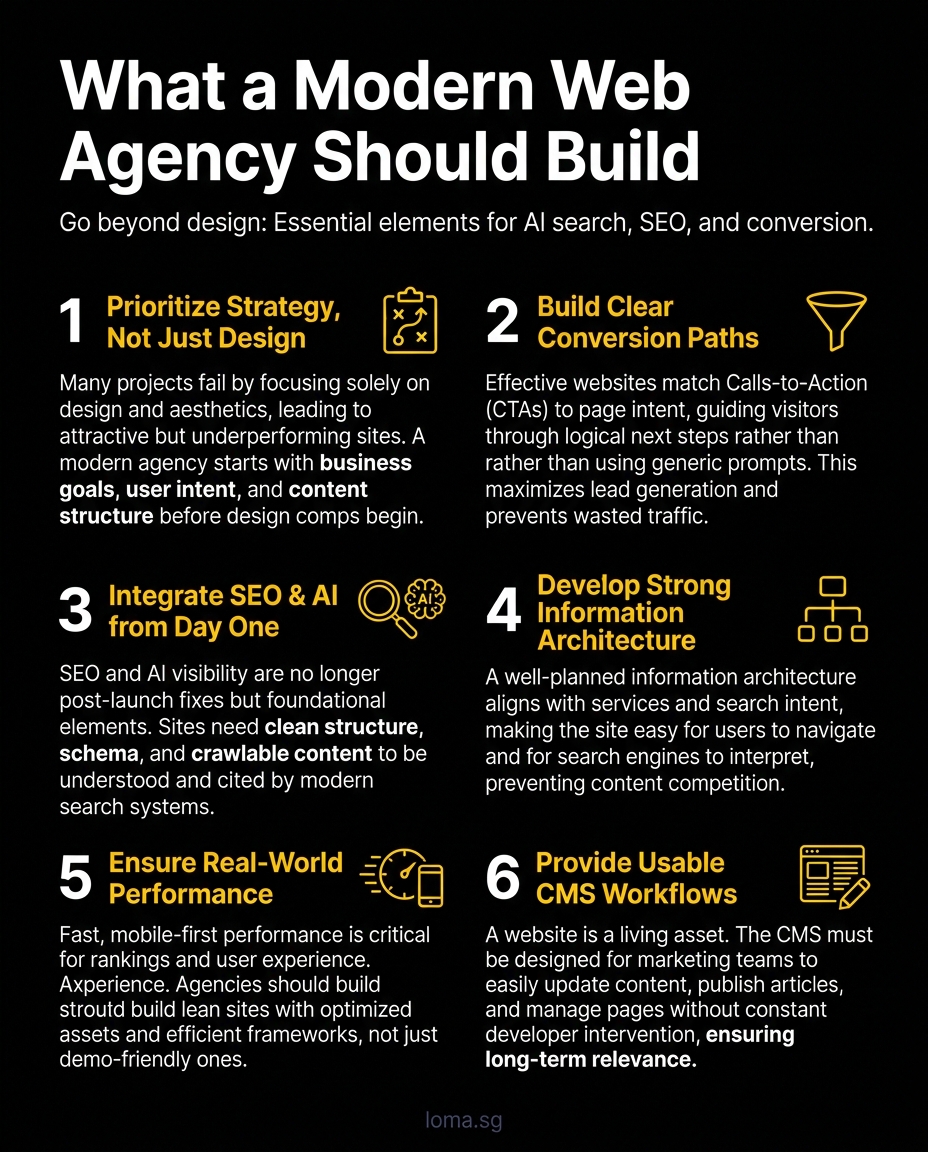
Most failed website projects do not fail because the code breaks. They fail because the thinking was wrong from the start.
Design gets treated as the strategy
This is the oldest trap in the category. A business asks for a redesign. The agency responds with moodboards, homepage concepts, and a prettier navigation. Everyone talks about brand polish. Almost nobody talks about what the site needs to rank for, which pages should convert, or how the content should be structured so AI systems can interpret it.
Good design matters. Bad design hurts trust. But design is the wrapper, not the operating system.
If a page looks sharp but says very little, targets the wrong intent, and buries the CTA, it is brochure-ware. Brochure-ware is expensive, and it ages badly.
There is no clear conversion path
A surprising number of business sites still expect visitors to "figure it out".
The homepage introduces the brand. Service pages stay vague. Contact options are hidden in the footer. Forms ask for too much or too little. There is no clear next step for someone who is interested but not ready to speak yet.
A conversion-focused build should answer three questions on every important page:
- What do you do?
- Why should I trust you?
- What should I do next?
If the page cannot answer those quickly, traffic becomes waste.
SEO and AI visibility get bolted on later
This is where redesigns become costly. Once the layout is approved, nobody wants to revisit page structure, heading hierarchy, internal links, schema, FAQ blocks, or content depth. So SEO gets reduced to title tags and wishful thinking.
That worked poorly even before AI search. Now it is worse.
Search engines and AI answer engines both need structure. They need pages that clearly define a service, explain who it is for, answer common questions, and connect related topics logically. If your site is visually polished but structurally thin, you are giving both Google and AI systems very little to work with.
What a modern web development agency should actually build
A good agency does not start by asking what style you like. It starts by asking what the website must achieve.
Information architecture aligned to search intent
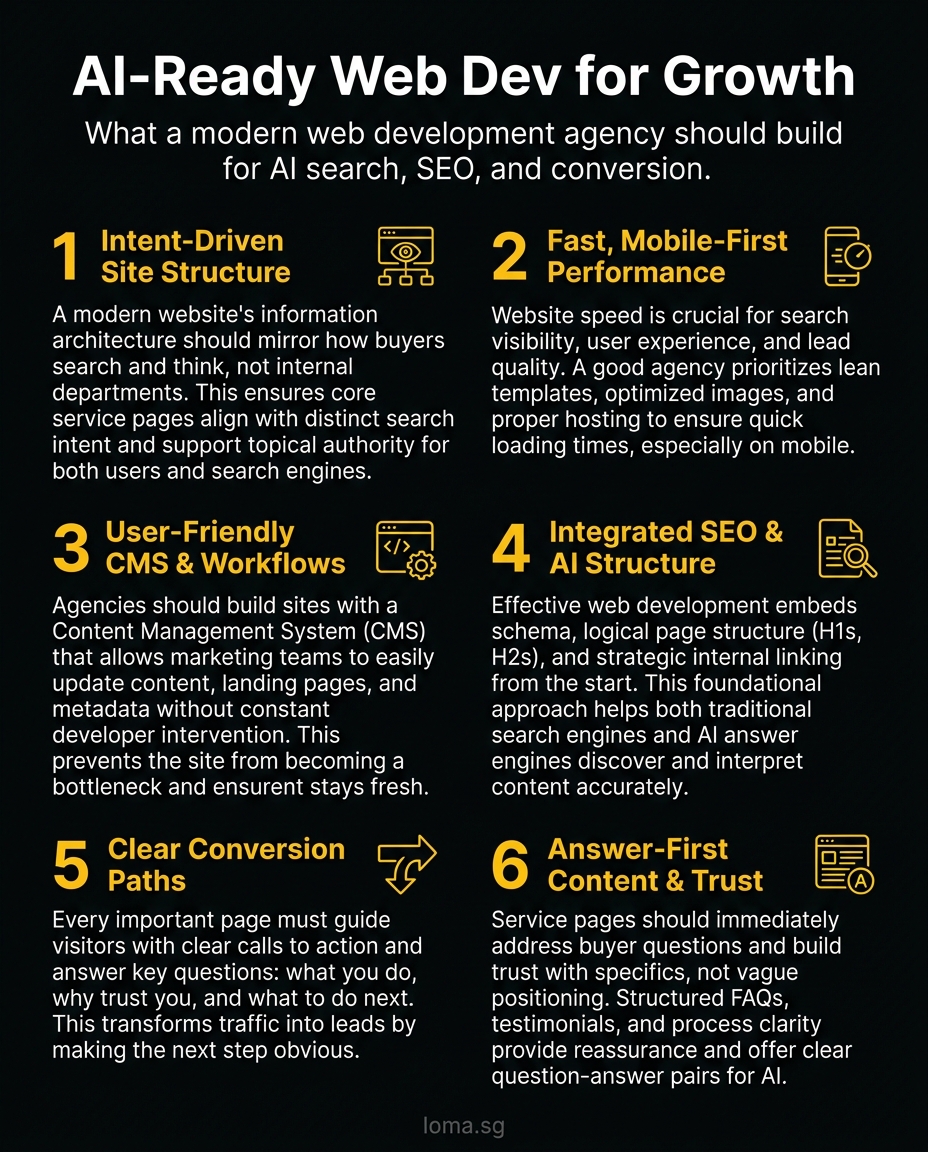
Your site structure should reflect how buyers think and search, not how internal teams label departments.
That means core service pages built around distinct intent. It means related supporting pages that strengthen topical authority. It means a navigation system that helps both users and crawlers understand what matters most.
For example, if you offer web development, SEO, and AI search strategy, those should not be crammed into one generic services page. They need clear pathways, clean URLs, and content that explains the differences. This is also where strategic internal linking matters. A build that supports both web development and AISEO from the start gives your content room to grow instead of forcing awkward retrofits later.
Fast, mobile-first performance
Performance is not a developer vanity metric. It affects search visibility, bounce rate, and lead quality.
A slow site makes every paid click more expensive. It makes mobile visitors less patient. It also signals sloppy execution. If an agency cannot deliver reasonable performance on a modern stack, you should question what else they are glossing over.
This does not mean chasing perfect Lighthouse scores for bragging rights. It means practical discipline:
- lean page templates
- compressed images
- sensible script loading
- clean component choices
- hosting and caching set up properly
Speed is a business decision disguised as a technical one.
CMS and workflows your marketing team can actually use
Some agencies build sites that only developers can update comfortably. That is a bad handoff.
A proper build should give your team control over landing pages, case studies, blog content, FAQs, metadata, and basic on-page updates without fear of breaking the layout. If publishing a new article or adjusting a CTA requires engineering support every time, your website becomes a bottleneck.
This is one area where many redesign projects quietly fail. The site launches, the agency disappears, and internal teams stop updating content because the workflow is annoying. Six months later the site is stale, rankings stall, and everyone blames marketing.
The real issue was build quality. A usable CMS is part of conversion infrastructure.
Schema, page structure, and internal links that support discovery
This is where a strategic web development partner separates itself from a design shop.
Every important page should have a clear H1, logical H2s, concise supporting copy, and room for proof elements, FAQs, and CTA blocks. Structured data should not be an afterthought. Schema helps search engines interpret entities, services, FAQs, and organisation details. Clean internal linking helps authority flow through the site instead of pooling uselessly on the homepage.
AI systems also favour pages that are easy to parse. Clear sections. Direct answers. Specific wording. Strong supporting context. If your pages are built like layered ad copy with no information density, they may look premium while staying invisible in answer engines.
The non-negotiables for an AI-ready, conversion-focused site
Not every website needs the same stack. Every serious business site does need the same fundamentals.
Answer-first service pages
Your service pages should answer buyer questions immediately.
What do you offer? Who is it for? What problem does it solve? How is your approach different? What happens next?
Too many pages still open with vague positioning and a stock photo. That is wasted real estate. A service page should earn attention fast, then deepen trust with specifics.
Structured FAQs and trust elements
A visitor who is evaluating an agency wants reassurance, not abstraction.
That means testimonials, proof points, process clarity, FAQs, and examples of what working together looks like. It also means reducing ambiguity around timelines, scope, deliverables, and ownership.
Structured FAQ sections do double duty. They help human readers resolve friction and give search systems clearer question-answer pairs to interpret.
Analytics readiness and lead capture flow
A website without tracking discipline is not finished.
Your agency should define what counts as success before launch. Form submissions, call clicks, WhatsApp clicks, booked consultations, content downloads, or qualified lead events should all be measurable. If the build goes live without clean analytics, the team loses the ability to learn what is working.
Lead capture also needs intent-based design. Not every visitor wants the same CTA. Some are ready for a consultation. Others want a checklist, audit, or case study first. Smart builds create more than one useful path into the funnel.
CTA placement tied to business goals
This sounds obvious. It often is not.
If the site exists to generate enquiries, your CTA strategy should not depend on one lonely contact button in the header. Pages need contextual calls to action that match the visitor's stage of awareness.
A founder comparing agencies may want a strategy conversation. A marketing manager reading an SEO-heavy article may want help aligning content, technical setup, and AI visibility. A good build places the right ask in the right place instead of repeating the same generic button everywhere.
Questions to ask before hiring a web development agency
If you are evaluating partners, ask questions that expose how they think, not just what they can design.
How do you plan content structure before design?
If the answer is vague, be careful. Content structure should shape the layout, not the other way around.
How do you support SEO and AI search visibility?
If they only mention metadata, that is not enough. Ask about schema, information architecture, internal linking, content modules, and how pages are written for both search intent and machine readability.
What CMS setup will my team actually maintain?
The wrong CMS setup creates hidden operating costs. Ask who can edit what, how reusable content blocks work, and what day-to-day publishing will feel like after handover.
How do you handle performance, tracking, and post-launch improvement?
Launch is not the finish line. It is the start of measurement. Your agency should have a view on site speed, analytics implementation, conversion tracking, and what gets improved after real users hit the pages.
What LOMA builds differently
At LOMA, we do not treat web development as a beauty contest.
We build sites to perform across three layers at once: visibility, usability, and conversion. That means structuring pages around intent, building content systems marketing teams can use, and making sure the technical foundation supports both SEO and AI search extraction from day one.
It also means we do not isolate web development from growth strategy. A redesign that ignores search behaviour, answer-engine visibility, and conversion flow is not modernisation. It is decorative spending.
If you are planning a new build or fixing a redesign that looks better than it performs, explore our web development services. If your bigger concern is how your site appears in AI-driven search experiences, our AISEO approach connects technical structure, content clarity, and machine-readable visibility. You can also browse more practical guides on the LOMA blog.
The right agency should not just ship pages. It should build a website that can be found, understood, and acted on.